
Posted on March 20, 2026 by Erik in Home Sellers, Landlords
So You Became an Accidental Landlord – Now What?
Key takeaways:
- With current interest rates, renting a mortgaged home will almost always lose you money
- The average cost of property management is roughly 10% of total annual rents
- Landlords typically devote 100+ hours/year to each rental property for management and maintenance, even with a full time property manager doing the majority of the work
- Selling a rented home is usually more difficult than selling a vacant one
- Rental leases must be honored during a sale
- Selling a house as-is with tenants in place to an investor is a top option
Most business owners start with a vision, a comprehensive gameplan, some kind of direction for how to make their business successful. This is especially true for landlords who own and manage single-family rental homes – where everything from maintenance to annual taxes has to be accounted for in order to ensure your operation stays in green figures.
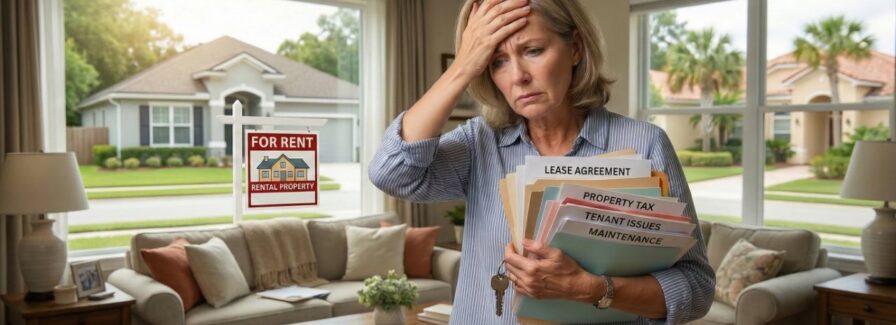
So when your forever home becomes an accidental rental and you find yourself stepping into the shoes of a landlord, you are already way behind. It’s decision time, and you don’t have long to get things in order.
How do you become an accidental landlord?
Most “accidental landlords” are created the same unfortunate way: failing to sell a home you need to get rid of, with renting it the only way to to not end up underwater, or worse, losing it to foreclosure.
There are many reasons for wanting to be rid of a home: relocation, divorce, inheritance, or the loss of a job, just to name a few. In many of these situations, time is of the essence, meaning you need to sell fast. But when a buyer can’t be found and the bills keep coming, renting becomes a way of subsidizing your mortgage, effectively putting off the problem for another day without actually solving anything.
What does being a landlord entail?
Being a landlord is a lot of responsibility. Think of how much you had to do when you lived at the house, and realize that almost all of those responsibilities are still yours…only now you have to manage them through others and rely on other people to show care and attention to ensure hidden problems don’t develop. But first you’ve got to prep the house and find a tenant.
Prep:
- Cleaning & repairs on any deferred maintenance: Your rental needs to be clean and free of any damage that could harm your renters or allow further wear and tear on the home. That can be as simple as some new paint, or a complete remodel with a new roof, AC, or other major component.
- Insurance: Just because someone else lives there doesn’t mean the insurance is their responsibility. As a landlord, you will need to carry insurance on the dwelling as a rental property. Any damage your tenant causes, or any injury caused to your tenant or their guests can become your responsibility as the home owner!
- Listing: Much like listing your home for sale, you’ll need to photograph and prepare marketing materials for your rental. For some this may not be as difficult, as a failed sale listing may still have listing photos available for use (be sure to check your licensing rights with your photographer!) You may choose to use real estate rental platforms like Zillow or even hire a real estate agent to list it on the MLS. During this step you’ll have to research pricing to ensure you set a fair rent value for your rental.
- Work with a service to create a legal lease agreement to, or hire an attorney to draft one for you to use when you find a renter.
- Decide if you want to hire a professional property manager for your rental. Most property managers charge 10% of annual rents as a minimum, but can save you dozens of hours of work each year on your rental.
Tenant Screening:
Once you have the rental house listed, the next step is to screen potential tenants who apply to rent your home.
- Either utilize a vetted service for listing applications or create your own by consulting with a real estate attorney (it’s important to understand local, state, and federal guidelines for renting, including the EHO.
- Find a trusted service for background & credit checks.
- Meet with prospective tenants to show them the home & learn more about who might be renting your property.
Leasing & Ongoing Maintenance
After you find a suitable tenant that matches your screening requirements, you need to agree on lease terms, sign an agreement, and prepare for your tenant to move into their new rental.
- Sign the lease agreement after confirming all details are correct. Do you allow pets? Who pays the utilities? Are there late fees for non-payment?
- Collect a security deposit. Note: before you can collect a security deposit, you need to create an account specifically to hold security deposits with your bank to avoid commingling of funds.
- Perform a move-in check to ensure you clearly document the property condition prior to move-in. This will be important if there is any dispute or damage after your tenant moves out.
- Put a system in place for maintenance requests & routine inspections. Most tenants will gladly accommodate quarterly inspections to ensure that no maintenance is needed to protect the home. But be prepared for late night calls for broken plumbing, bad AC’s, storm damage, or worse. Some items will need to be fixed promptly or else the tenant may be able to without rent or request alternative accommodations on your dime.
- Have an attorney or plan in the event your tenant fails to pay rent. Evictions can take as long as three months in Florida. Failure to follow procedures exactly as required can cause unforeseen delays in getting your rental turned and back out on the market.
In total, you can expect to devote a few hundred hours a year to service calls, prep, taxes, accounting, marketing, screening, and all of the other responsibilities of leasing a rental property. A property manager can save you a significant portion of this time, but will come at the cost of a percentage of your rents.
How much can I earn from my rental?
For most professional landlords, being landlords who run their rental business as their primary income maker, rents need to have a positive cash flow (more money coming in than going out) to make sense as a potential addition to their portfolio. For a professional landlord, the usual target is for a rental to earn 5-10% of the home’s value each year in gross rental income, with about 7% as the industry standard. Many rental investors use the 1% rule, meaning that the monthly gross rent needs to be at least 1% of the home’s value in order to be worthwhile.
For Accidental landlords, the math gets a whole lot harder. Current mortgage interest rates sit at about 6.1% as of 03/20/2026, the original date of this article. When you factor taxes, insurance, and your principal, you’ll quickly find that it’s difficult to positively cash flow a rental property. Instead many accidental landlords are simply hopeful to offset their mortgage costs at a small loss, making an overall return through appreciation in the value of the property itself. In most cases, that may realistically look like spending $400-500/month net after all of your rental incomes and expenses. If you have a more favorable mortgage at a lower rate, cash flowing is more feasible.
Selling a rental property
Maybe being a landlord isn’t for you, but you’ve already put a renter in your home. What are your options for selling it? The good news is it is absolutely possible to sell an occupied rental property. But there are a few things that make it tricky.
- Is the rental cash flowing? – if your tenant is performing (paying their rent) and the rental meets the 1% yield rule, a buyer may want to take it “turn-key” meaning they’ll purchase it with the renter in place. If it isn’t cash flowing, you’ll have a harder time finding a buyer.
- Are you able to show the home? – One of the biggest hurdles to selling a home is accessibility. If potential buyers need to jump through hoops or wait long periods of time to see the inside or take a tour, selling is much more difficult.
- Is it rented at market rent? – Leases don’t disappear when you sell the home. A potential buyer needs to be aware of all lease terms and be provided with a copy of the lease and financials prior to your sale. If your home is leased but renting below market (maybe you kept rent low to entice a tenant and avoid vacancy), buyers may elect to pass rather than take a loss on a fixed period of below market rent.
- Are your renters taking care of the home? – Many renters take great care of their rented properties…others not so much. If your tenants are trashing the place, buyers notice. Selling a home with bad tenants is incredibly difficult as buyers must undertake a serious risk of further damage and/or missed payments and evictions.
The easiest way to sell your rental property
While it is possible to list a rented home and sell it the traditional way, most accidental landlords have already tried to go that route and failed to procure a buyer. Doing it again with a tenant in place is unlikely to improve the situation.
For most accidental landlords, cash buyers, usually real estate investors are the way to go. An experienced cash buyer in your market will have an in-depth knowledge of local rules, customs, rental values, property values, and everything else needed to make an educated cash offer for your rental. Most true cash buyers will be willing to take an occupied property, sometimes even below market rent, and can even take over situations where an eviction or other action may be necessary, saving you the headache as well as the money.
In exchange for the ease of selling for cash, expect to earn a little less on your sale than you would with a traditional listing – about 80 cents on the dollar is typical. However, you’ll offset some of that discount by saving on closing costs and real estate commissions, so while the final number is usually less, it’s often not by a huge margin.
Final considerations for accidental landlords
Before trying to rent your failed listing, be sure to check with local governing bodies, including HOA’s. Many homeowners associations, especially in Jacksonville have very tight restrictions about renting properties, often requiring applications and approvals, and may limit things like: what pets a tenant can have, how often you can rent your home, how long you have to have lived in your home prior to renting, minimum lease terms, and more.
Some cities may allow for short term rentals, usually for vacation purposes. In Jacksonville, the beaches are and historic districts allow for short term vacation rentals, but they are prohibited elsewhere.
Ultimately, turning a failed sale into a rental property can be a good way to avoid losing the home, and in some cases can even offer a net positive return from the rents. However, for more individuals exploring this option, the legal headaches, maintenance requirements, and day to day management is more than sufficient to offset any income, effectively turning your home into a second part-time job. It’s worth your time to explore all of your options prior to putting a tenant in place if you think there is any chance you might want to sell.
About the Author:
Erik Jacobson is the Director of Brand Marketing, and the Operations Director for Duval Home Buyers, LLC and Wholesale Realty, LLC in Jacksonville. Erik has spent the last 8 years engrossed in the world of real estate investment, working to find new ways to improve the experience for sellers looking for an easier option in Jacksonville. In his spare time, Erik is an avid reader and writer, offering general advice and consultancy on marketing and brand positioning.
Duval Home Buyers celebrates the unique expertise and perspective of the professionals that make up its organization. The views and opinions expressed in this article are those of the author, and not necessarily those of Duval Home Buyers, LLC or its affiliates. This article is not intended to be real estate or legal advice.